SAMCARA Project
Researcher: Masaya Sugiura
Inquiries Regarding Joint Research and Collaborative Development
masaya69@keio.jp
Project Title
Application of Adaptive Bacterial Ink Utilizing Microbial Dynamics for Architectural Coatings
For more information:
IPA MITOU Advanced Program – Project Overview
Project Overview
This project aims to facilitate the social implementation of bacterial ink by exploring its potential as a novel architectural coating technology in Japan.
In recent years, the fields of architectural coatings and industrial inks have faced increasing challenges, including dependence on petroleum-derived materials, volatile organic compound (VOC) emissions, and the environmental burden associated with repainting and maintenance. In addition, recent global supply chain disruptions have created instability in the availability of raw materials used for industrial coatings.
Meanwhile, microorganisms have long been utilized by humanity in fermentation, food production, and medicine. In Japan, microorganisms have played a particularly significant cultural and industrial role through traditional brewing practices such as miso and sake production. However, the application of bacterial growth and colony formation themselves as a living ink for architectural surfaces has remained largely unexplored.
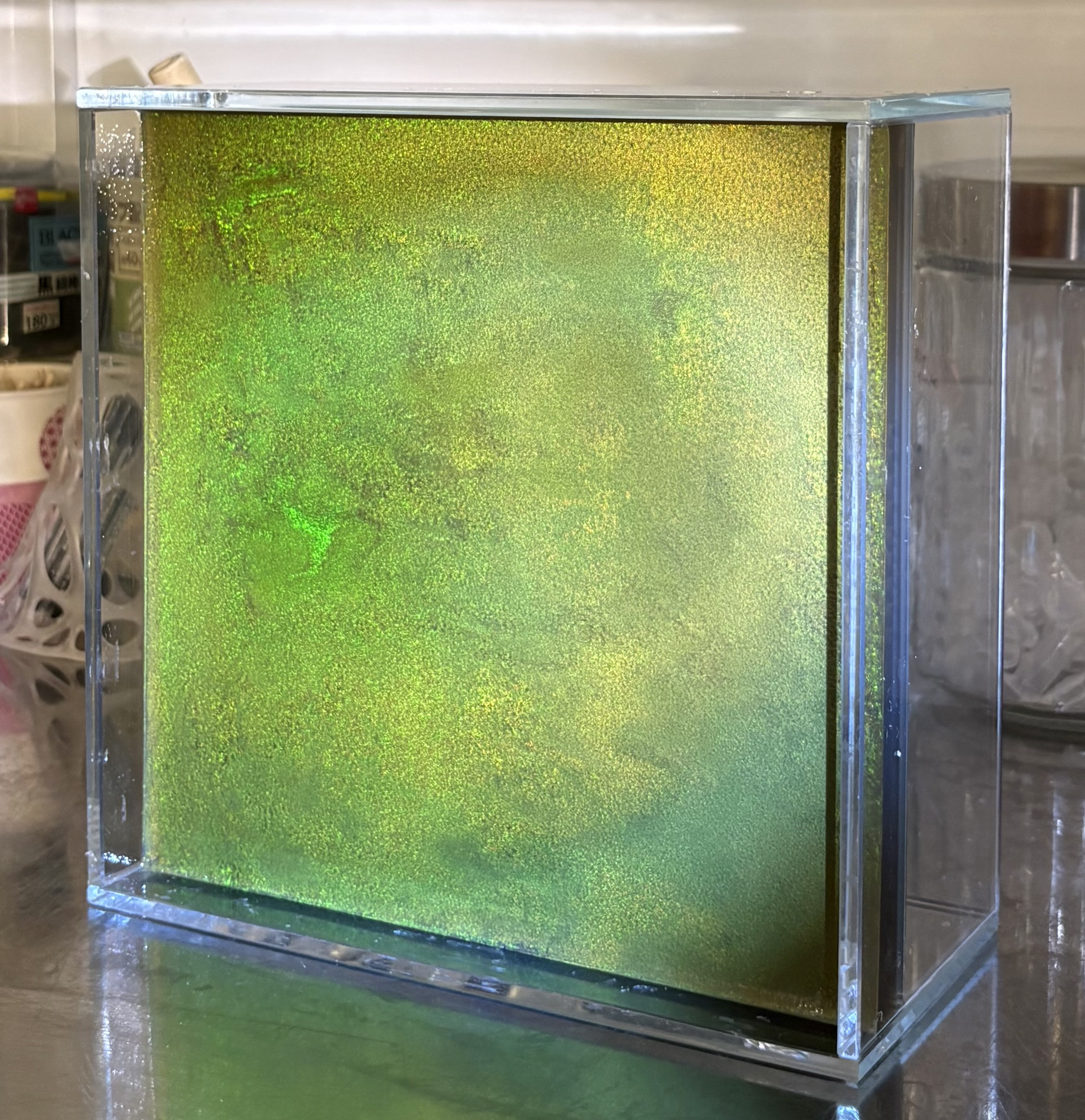
This project focuses on structurally colored biofilms produced by bacteria and investigates how microorganism-derived coloration can be incorporated into architectural coatings. Whereas conventional coating technologies have emphasized uniformity and durability, this research regards environmental responsiveness and continuous transformation as integral design qualities. By examining growth conditions, surface adhesion, and stabilization methods, the project seeks to establish a new form of architectural surface expression that balances long-term viability with aesthetic value.
Looking toward practical implementation, the project will collaborate with partners in the building materials and coating industries to develop prototypes, conduct performance evaluations, and verify real-world applications in architectural environments. Rather than treating bacteria merely as a material, this research positions them as collaborative living agents that generate dynamic visual expressions through interactions with their surroundings. In doing so, the project proposes a new relationship between humans and microorganisms and explores the future of biologically responsive architecture.
Ultimately, this project aims to achieve the social implementation of bacterial ink as a next-generation architectural coating technology that simultaneously reduces environmental impact and creates new forms of aesthetic value.
Related Projects and Research Grants
CHROMA LIFE PROJECT
In parallel with this project, the CHROMA LIFE PROJECT was selected for the following grants and programs during Fiscal Year 2025 (Reiwa 7):
Matsuura Art Foundation
https://matsuura-foundation.org/business/#result
Kao Foundation for Arts and Sciences
https://www.kao-foundation.or.jp/art/art_assistresult/
100BANCH
https://100banch.com/projects/chroma-life-project
Future Materials Bank
https://www.futurematerialsbank.com/material/cytophaga-lytica-iron-bacteria-cyano-bacteria/
This funded project focuses on artistic research exploring the integration of bacterial ink with traditional letterpress printing. Activities include material research conducted in collaboration with Kyoto washi artisans and the printing company Shubisha, experimental printing using Japanese oil-blotting paper (aburatorigami), workshops, exhibitions, and archival production.
Accordingly, the CHROMA LIFE PROJECT is an independent research initiative centered on artistic practice and creative expression. It is distinct from the IPA MITOU Advanced Program project, whose primary objective is the social implementation of bacterial ink as an innovative architectural coating technology. Although both projects involve bacterial ink, they differ fundamentally in their research objectives, methodologies, and expected outcomes.